Bishamonten
Statuary
- Contact Us
-
Material
Wood, glass beads and traces of polychromy
-
Size
35 x 32 x 87 (h) cm
-
Period
Kamakura period (1185–1333)
-
Scientific Dating
Carbon-14 dating: 1264–1296
Description
Statue of Bishamonten
Japan, 13th century
A protective deity of the Buddhist pantheon and Guardian of the North, Bishamonten vanquishes demonic forces and protects sacred treasures. A characteristic work of the Kamakura period.
Bishamonten Subduing a Yaksha
Buddhist protective deity
Japan, Kamakura period (1185–1333)
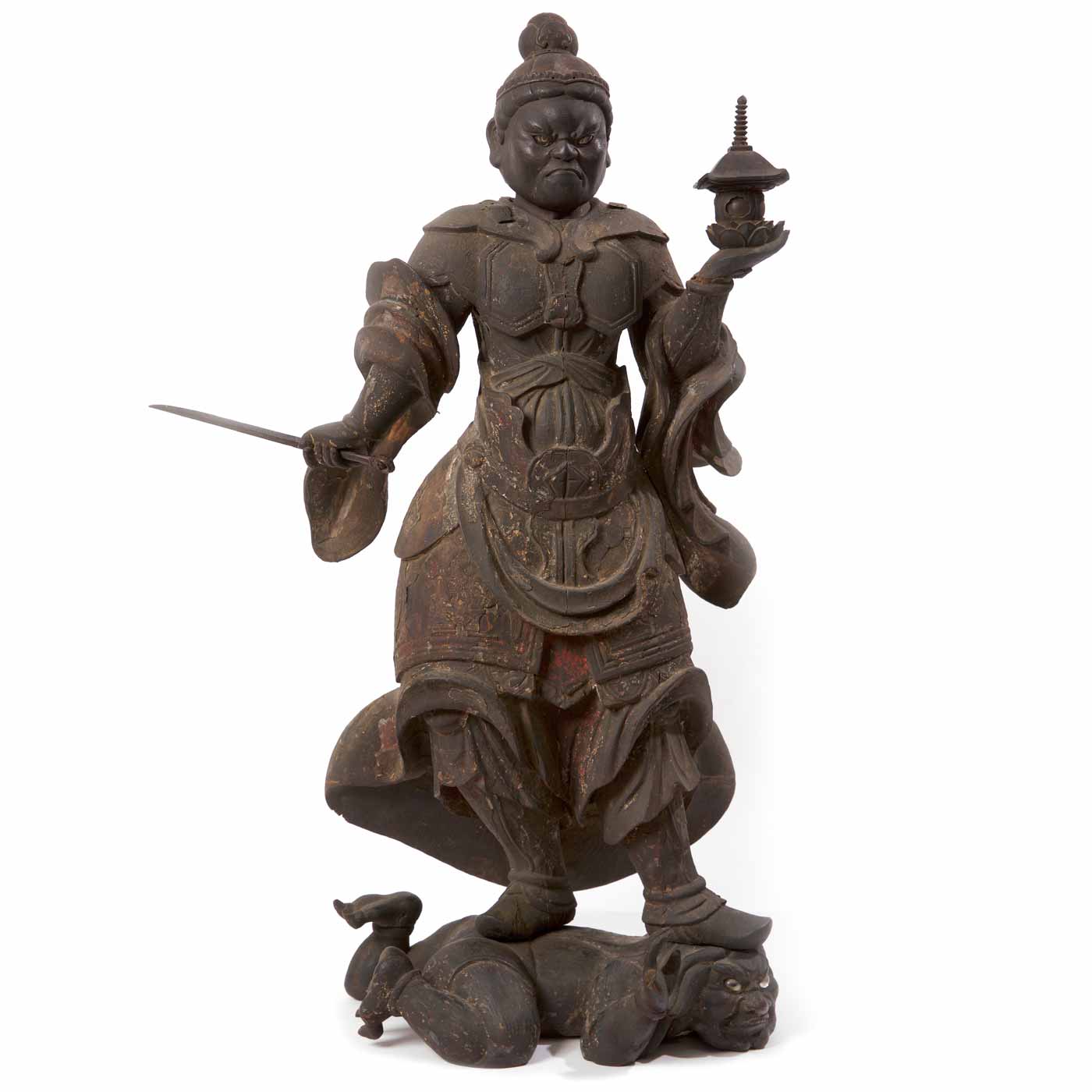
This sculpture represents Bishamonten (毘沙門天), also known as Tamonten, the Japanese form of Vaiśravaṇa and one of the Shitennō, the Four Heavenly Kings who guard the cardinal directions in East Asian Buddhism. Guardian of the North, Bishamonten occupies a distinctive place in Japan: defender of the Buddhist Law, protector of temples and sacred treasures, he also embodies a martial dimension and may be invoked to grant protection, victory and prosperity.
The deity is depicted here according to a characteristic iconographic type. Clad in imposing Chinese-inspired armour, he stands upon an overturned yaksha, representing hostile forces subdued by the Buddhist order. In his left hand, Bishamonten holds a small pagoda, one of his distinctive attributes and a symbol of the sacred treasure entrusted to his protection. His right hand brandishes a straight blade, probably a short sword, emphasising the figure’s martial character. The contrast between the deity’s commanding stance and the constrained body of the yaksha powerfully expresses the triumph of the Buddhist Law over the forces of disorder.
The work is distinguished by a formal tension characteristic of Buddhist sculpture of the Kamakura period. The stability of the stance, the wide positioning of the legs and the powerful volume of the torso contrast with the movement of the drapery and the animated figure of the yaksha. This opposition gives the composition a presence that is at once monumental and dynamic. The compact, powerful face, with strongly furrowed brows and an intense gaze, further reinforces this impression of authority. The surviving eyes, inlaid with glass beads, heighten the figure’s presence and reflect the pursuit of realism and expressive intensity that characterises an important part of Buddhist sculpture during the Kamakura period.
Traces of polychromy survive on several areas of the armour and garments, offering a glimpse of the sculpture’s original richness. They remind us that the work was originally conceived as a polychrome image, in which colour and the brilliance of the gaze contributed fully to the deity’s cultic presence. At his feet, the yaksha, whose contorted body and highly expressive face contrast with Bishamonten’s commanding composure, is far more than a simple iconographic support: it contributes fully to the visual and symbolic power of the composition.
Carbon-14 dating, which places the wood between 1264 and 1296, situates the work at the heart of the Kamakura period, one of the major chapters in the history of Japanese Buddhist sculpture. During the 13th and 14th centuries, Buddhist statuary was notably characterised by renewed attention to the physical presence of the figure, the individualisation of facial features and expressive intensity. This representation of Bishamonten offers a remarkable synthesis of these qualities: the power of the body, the concentrated expression of the face and the movement of the drapery combine to give the deity an immediate and commanding presence.
Intended for a religious setting, most likely a Buddhist temple, this sculpture thus combined a protective function with iconographic power and devotional presence.
For comparable representations of Bishamonten from the Kamakura period, see, among others, the collections of the Los Angeles County Museum of Art, the Metropolitan Museum of Art, the Asian Art Museum of San Francisco and the Tokyo National Museum.
«